
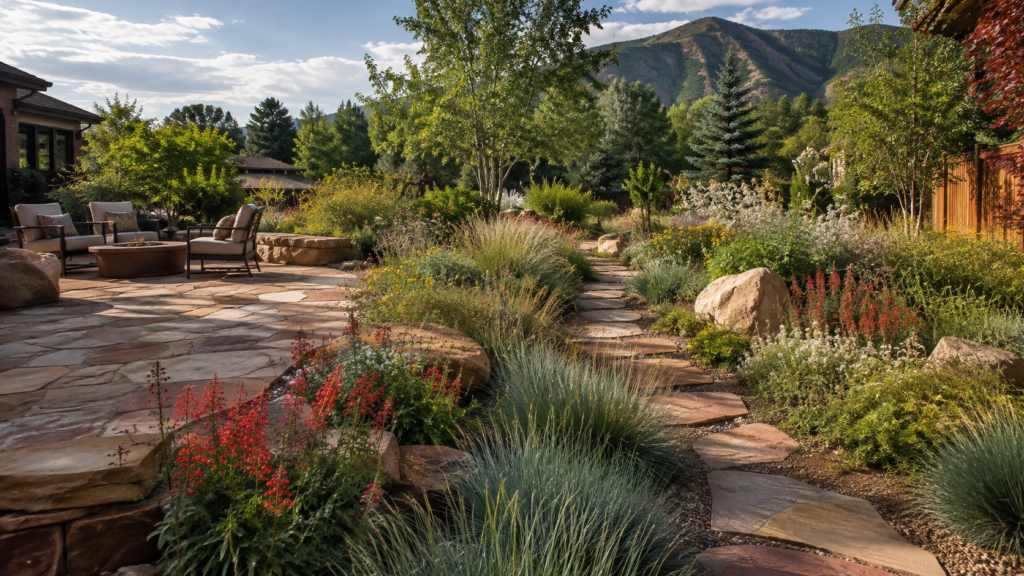
Utah Backyard Xeriscape Ideas With Native Plants help homeowners create beautiful, low-water landscapes designed for Utah’s unique climate, elevation, soil conditions, and water limitations. These xeriscapes combine native grasses, flowering perennials, shrubs, trees, and functional outdoor spaces to reduce unnecessary irrigation while keeping the backyard useful and attractive.
Utah contains seven major Level III ecoregions and approximately 3,277 native vascular plant species, so a plant being native to Utah does not automatically mean it belongs in every Utah backyard. A St. George landscape can require very different plants from a yard in Logan, Salt Lake City, Park City, or a higher Wasatch community.
The best strategy is simple:
- Keep lawn where it serves a real purpose.
- Identify hot, dry, shaded, and poorly drained areas.
- Group plants with similar water requirements.
- Choose plants according to mature size.
- Use rock and hardscape for specific functions rather than as substitutes for vegetation.
Utah Backyard Xeriscape Ideas
When planning Utah Backyard Xeriscape Ideas With Native Plants, the best approach is to match each plant with the site’s sunlight, drainage, elevation, and irrigation zone rather than choosing plants only because they are drought tolerant.
Start with the problem you need the landscape to solve instead of choosing plants first. A sunny unused lawn, hot west-facing wall, privacy problem, pollinator goal, and drainage route each require a different design response.
Useful starting combinations include:
- Unused sunny lawn: blue grama with repeated flowering natives.
- Hot exposed bed: globemallow, buckwheat, and other site-suitable xeric plants.
- Hummingbird garden: firecracker penstemon near a patio or frequently viewed window.
- Privacy: layered Apache plume, serviceberry, or mountain mahogany where suitable.
- Southern Utah bed: architectural plants such as Utah agave and Mormon tea.
- Fence line: a pollinator corridor of grasses, flowers, and shrubs.
- Drainage route: a planted dry creek or swale based on actual runoff.
- Small unused corner: a habitat pocket with one shrub, repeated flowers, and native grass.
A good xeriscape solves a backyard problem while lowering unnecessary irrigation. Do not add a dry creek because xeriscape photos usually contain one, or remove usable lawn simply because turf is unfashionable.
Why Use Native Plants in Utah?
Native plants can strengthen regional character, provide wildlife value, and reduce dependence on species poorly adapted to local conditions. However, native plants should be selected by habitat rather than by label alone.
Before choosing a plant, check:
- Elevation range
- Sun exposure
- Reflected heat
- Soil texture
- Drainage
- Mature height and width
- Long-term water requirement
Native also does not mean “never water.” Newly planted natives generally need establishment irrigation while roots expand into surrounding soil. The long-term goal is to reduce watering as appropriately selected plants mature.
A non-native plant can also be water-wise. Native status is most useful when it supports an already strong match between the species and the site.
Best Native Plants for Utah Xeriscapes
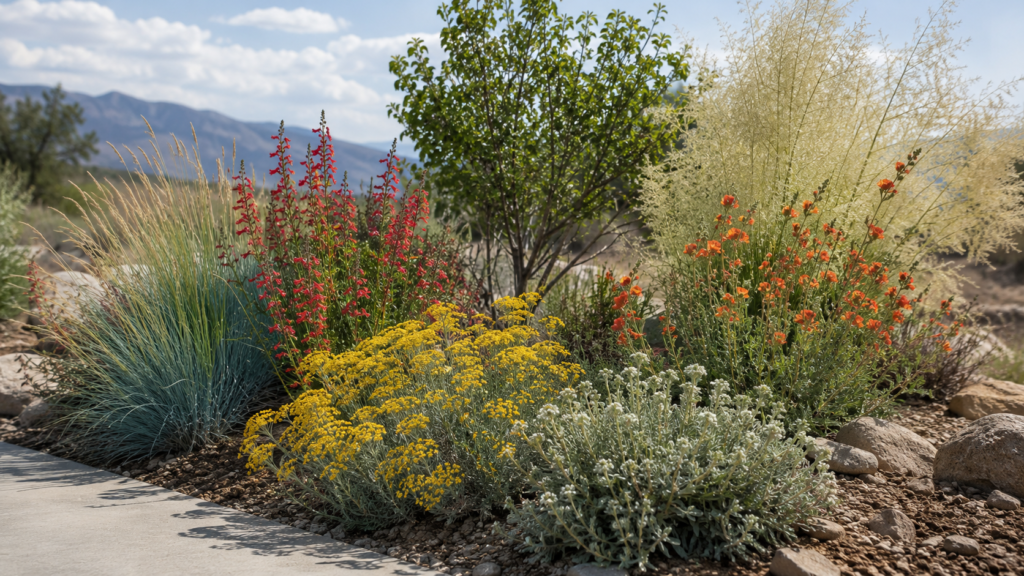
Use native plants as different landscape layers rather than collecting unrelated specimens.
| Plant | Best landscape role | Important site clue |
| Blue grama | Grass matrix | Sunny; avoid wet soil |
| Firecracker penstemon | Flower accent | Excellent drainage |
| Sulphur buckwheat | Low flowering mass | Dry, sunny sites |
| Globemallow | Summer color | Hot, exposed beds |
| Apache plume | Structural shrub | Dry, well-drained sites |
| Utah serviceberry | Wildlife shrub/screen | Allow mature space |
| Mountain mahogany | Large shrub/small tree | Low-water structure |
| Green Mormon tea | Architectural shrub | Dry, rocky soil |
| Fourwing saltbush | Dry-site shrub | Drought and salinity tolerant |
| Utah agave | Focal plant | Very sharp drainage |
| Gambel oak | Large screen/canopy | Needs substantial room |
Blue grama is particularly useful as a repeating matrix rather than as a conventional lawn substitute. Firecracker penstemon provides strong vertical color and hummingbird value, while Apache plume and serviceberry supply larger structure.
A cohesive plant palette may use:
- One matrix species
- Two or three flowering species
- One or two repeated shrubs
- One larger anchor where space allows
For example:
Blue grama + firecracker penstemon + sulphur buckwheat + globemallow + Apache plume + serviceberry
Repetition usually creates a more professionally designed result than using one specimen of every available native.
Choosing Native Plants for Your Utah Yard
Use a plant-location test before purchasing anything. The plant itself may be excellent while the intended location is unsuitable.
Utah Native Plant Site-Match Score
Score each category from 0 to 2.
| Factor | 0 | 1 | 2 |
| Sun/heat | Poor | Acceptable | Strong |
| Soil/drainage | Poor | Manageable | Natural fit |
| Climate/elevation | Questionable | Acceptable | Strong |
| Mature size | Conflict | Tight | Comfortable |
| Irrigation | Wrong zone | Compromise | Compatible |
8-10: strong candidate
5-7: investigate further
0-4: choose another plant or location
For example, firecracker penstemon might perfectly match the sun, soil, climate, and available space but share irrigation with plants that require frequent moisture. The plant is not necessarily wrong; the hydrozone is.
Also buy plants by botanical name whenever possible. Ask the nursery about mature size, drainage requirements, propagation source, and whether enough specimens are available to create repetition.
For most residential landscapes, nursery-propagated native plants are preferable to collecting plants from natural areas, where land-management rules, protected species, permits, and difficult transplant establishment can become issues.
Utah Backyard Xeriscape Layout
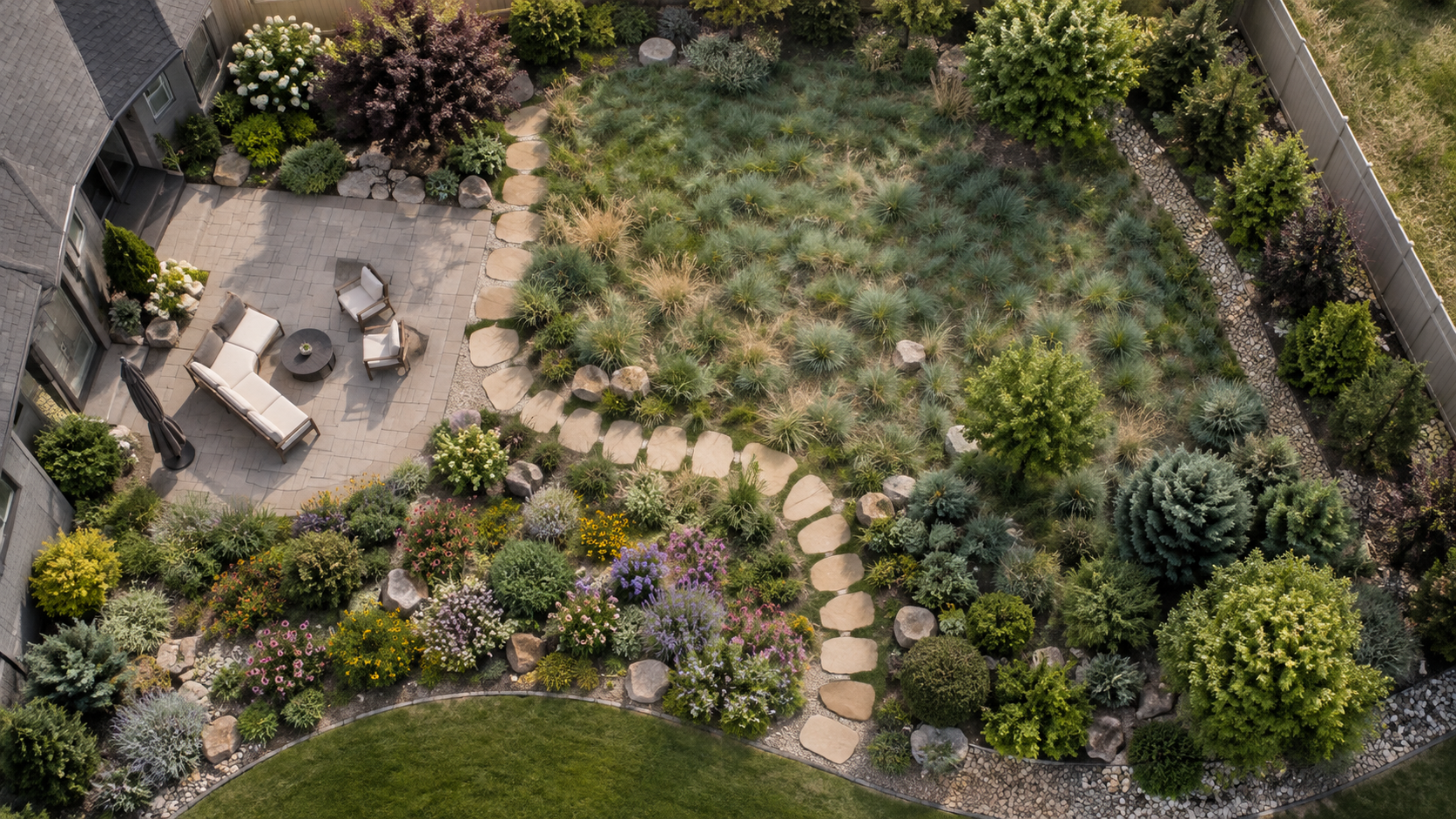
Organize the backyard from more human activity near the house to broader, lower-maintenance planting toward the property edge.
Zone 1: Outdoor Living
Keep patios, dining areas, grills, play space, and primary walkways. Xeriscaping should improve outdoor function rather than remove it.
Zone 2: Flowering Border
Place detailed plants where people can see them closely:
- Penstemon
- Buckwheat
- Globemallow
- Native grasses
Zone 3: Native Matrix
Replace broad areas of unnecessary turf with repeated low-growing planting such as blue grama where conditions suit it.
Zone 4: Structural Shrubs
Use shrubs for privacy, wildlife cover, wind filtering, and year-round form.
Zone 5: Property Edge
Reserve larger shrubs and trees for areas where their mature size can be accommodated.
A useful layout sequence is:
House → Patio → Flower Border → Native Matrix → Structural Shrubs → Property Edge
This arrangement also makes irrigation zoning easier.
How to Install a Utah Xeriscape
Good installation starts before lawn removal.
- Map the site. Record sun, afternoon heat, drainage, existing irrigation, utilities, paths, slopes, and established trees.
- Identify functional lawn. Keep turf used for recreation and question narrow strips, steep slopes, fence edges, and unused corners.
- Check rebates first. If you intend to apply for an incentive, complete required pre-conversion steps before removing grass.
- Draw mature plant sizes. Design with mature widths rather than nursery-pot dimensions.
- Prepare the site. Control weeds and remove unwanted lawn using a method appropriate to the property.
- Correct real soil problems. Do not automatically add rich soil to plants naturally adapted to lean conditions.
- Install hardscape and irrigation. Complete paths, drainage, edging, and irrigation modifications before planting.
- Plant largest to smallest. Start with trees and major shrubs, then add grasses and perennials.
- Water for establishment. Provide enough moisture for root development without permanently overwatering xeric plants.
- Mulch exposed soil. Choose organic or mineral mulch according to plant requirements and landscape function.
A phased conversion is also practical. Completing one planting zone successfully allows you to learn which plants perform best before repeating them throughout the property.
Utah Xeriscape Irrigation Guide
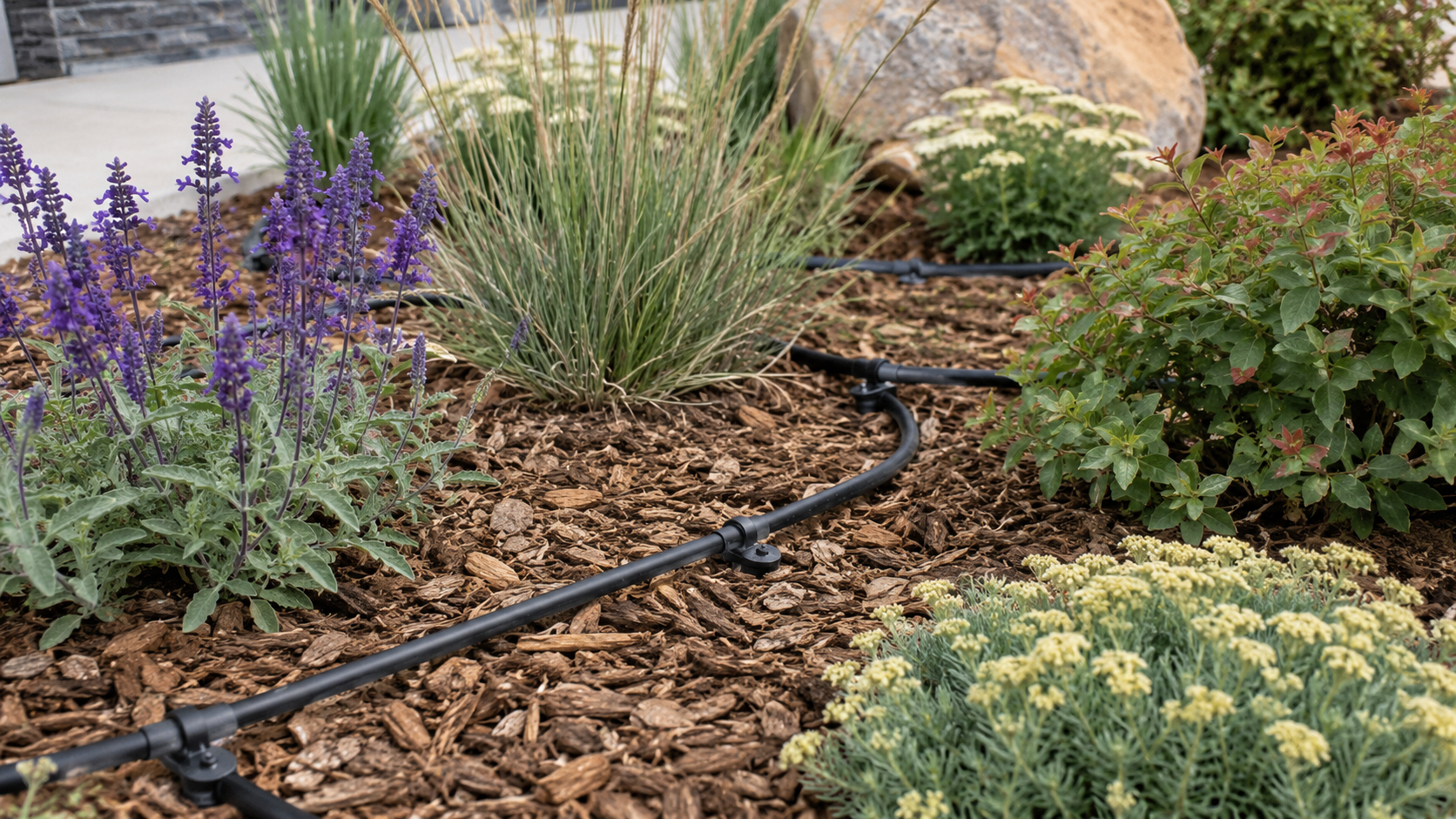
A xeriscape can contain excellent plants and still waste water if every area receives the same irrigation schedule.
Separate zones where possible for:
- Functional lawn
- Trees
- Shrubs
- Low-water perennial beds
- Vegetable gardens
Drip irrigation can target individual planting zones efficiently, but it still requires management. As shrubs mature, emitters may need to move outward so irrigation follows the expanding root system.
Watch for useful warning signs:
| Condition | What to investigate |
| Constantly wet soil | Excess frequency or poor drainage |
| Dry soil beyond the original root ball | Emitter placement |
| Xeric plants declining beside lush plants | Hydrozone conflict |
| Runoff before deep wetting | Application rate |
| Same schedule after several years | Establishment schedule never reduced |
The objective is not “water as little as possible.” It is to provide the correct amount of water at the correct location and then reduce unnecessary irrigation as plants establish.
Mulch and Gravel for Utah Xeriscapes
Gravel belongs in a xeriscape when it performs a job.
Good uses include:
- Paths
- Drainage
- Mineral mulch
- Utility access
- Architectural contrast
Organic mulch can be useful around many shrubs and perennials because it covers exposed soil and can help with weed management.
Avoid the common “plant island” design in which a few tiny shrubs float in a large field of gravel. Calculate plant coverage at maturity so vegetation eventually creates visual continuity, wildlife habitat, and seasonal character.
Hardscape should answer a practical question: Where do we walk? Where does water move? Where do we sit?
If its only purpose is filling space because you do not know what to plant, reconsider it.
Four-Season Utah Xeriscape Design
Flowers should not carry the entire landscape.
Design seasonal interest through several layers:
- Spring: emerging grasses, early flowers, and flowering shrubs.
- Early summer: penstemon and other vertical flower accents.
- Late summer: buckwheat, globemallow, grasses, and suitable later flowers.
- Fall: seed heads, grass color, fruit, and changing foliage.
- Winter: woody branching, evergreen structure, grasses, stone, and path geometry.
Use a simple test: imagine the yard with every flower removed.
If the design suddenly looks empty, add stronger grass masses, shrubs, or woody anchors rather than more flowering species.
Flowers create seasonal highlights. Structure keeps the landscape coherent all year.
Utah Xeriscapes for Wildlife
A pollinator-friendly xeriscape needs more than one flowering plant.
Combine:
- Tubular flowers
- Open flowers
- Clustered flowers
- Grasses
- Fruiting shrubs
- Multiple plant heights
Firecracker penstemon can provide hummingbird nectar, while serviceberry contributes fruit and woody habitat. Extend flowering periods rather than selecting every species for the same spring display.
Wildlife value is strongest when the landscape provides:
Food + shelter + seasonal continuity + plant diversity
Avoid unnecessary broad-spectrum pesticide use in areas designed specifically to support insects and other wildlife.
Firewise Utah Xeriscaping
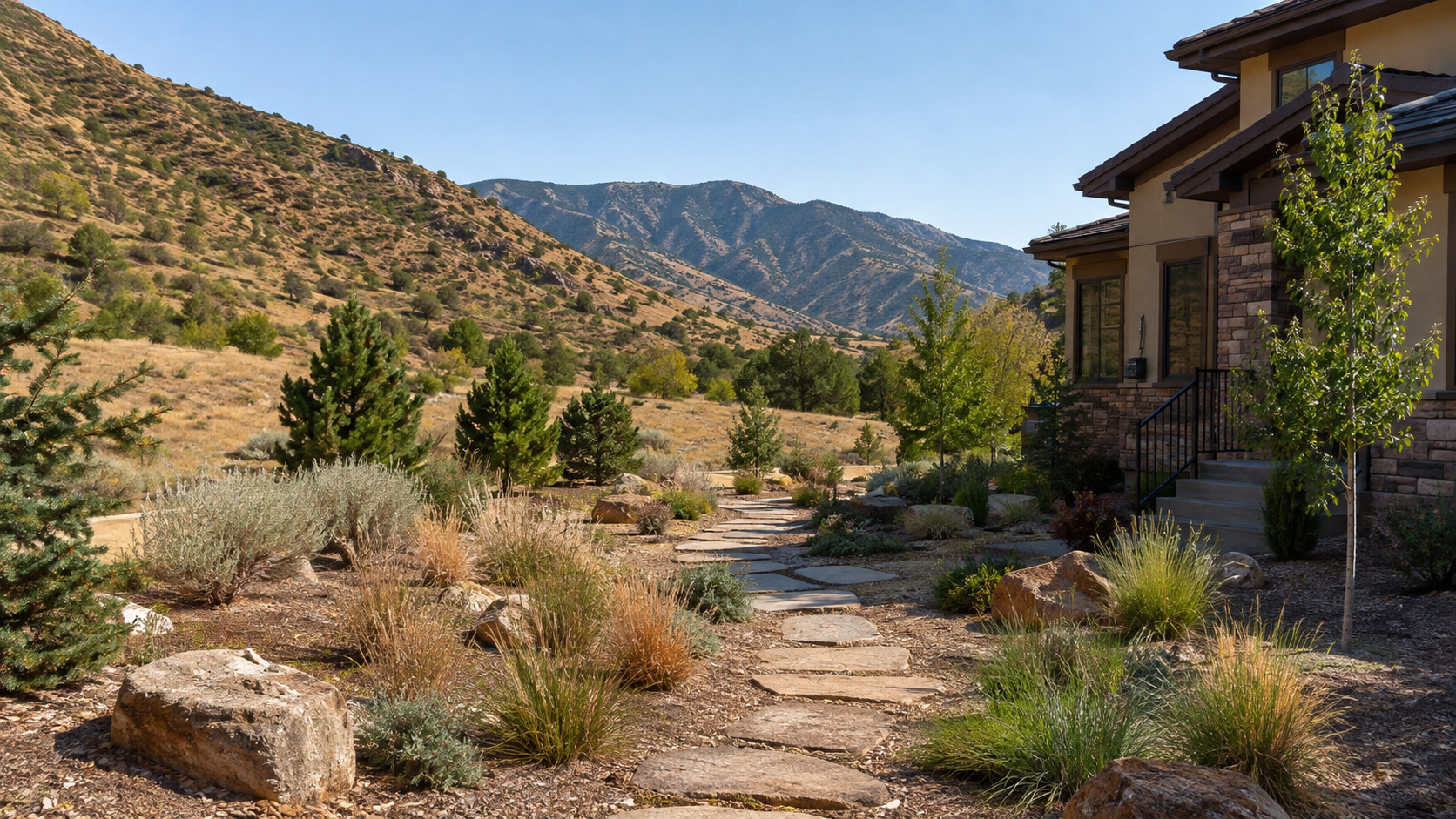
Native and drought-tolerant do not automatically mean fire-safe. This matters especially for Utah properties bordering foothills, canyons, or wildland.
Utah State University notes that firewise landscaping combines appropriate plant selection with placement, pruning, thinning, and maintenance to reduce fuel continuity around structures. No plant should be considered fireproof.
Where wildfire exposure is relevant, evaluate:
- Dense vegetation beside structures
- Dead grass and branches
- Shrubs touching buildings
- Continuous vegetation leading from wildland toward the house
- Plants below decks
- Vegetation along fences
A naturalistic planting farther from the house may require different spacing and maintenance from vegetation immediately beside a structure.
Utah Xeriscape Maintenance
Xeriscaping changes maintenance rather than eliminating it.
The first year usually requires the most attention:
- Establishment watering
- Weed removal
- Replacing failed plants
- Mulch maintenance
- Irrigation checks
Remove weeds before they produce seed. As desired plants reach mature size, more ground becomes occupied and some weed pressure can decline.
Prune shrubs according to their natural habit rather than automatically shearing them into geometric shapes. Constant severe pruning usually indicates that the plant is too large for the location.
Keep simple notes about which plants thrive, fail, reseed heavily, attract wildlife, or require unexpected water. Over time, those observations become a plant-performance database specific to your property.
Utah Xeriscape Rebates
Utah lawn-conversion incentives vary by community and water provider.
The Utah Division of Water Resources currently offers $2 per square foot for qualifying grass removed and replaced with water-efficient landscaping in eligible locations. Utah Water Savers notes that some participating programs offer incentives of up to $3 per square foot, so homeowners should verify the program applying to their exact address.
Current Division of Water Resources requirements include:
- At least 50% water-wise perennial or shrub canopy coverage at maturity
- Tree canopy excluded from that 50% calculation
- Low-volume drip irrigation
- Drip separated from overhead spray irrigation
- No lawn areas narrower than eight feet
- Permeable hardscape allowed when plant-coverage requirements are met
- Artificial turf, pools, water features, and concrete excluded as qualifying water-efficient replacement
Some provider programs add their own restrictions. Central Utah Water Conservancy District, for example, currently states that replacing traditional lawn with native or drought-tolerant lawn does not qualify for its lawn-removal incentive.
Most importantly, do not remove qualifying lawn before completing the required approval process. Check current rules before beginning because program requirements can change.
Common Utah Xeriscape Mistakes
Avoid these common problems:
- Replacing lawn with only rock: low water use alone does not create a good landscape.
- Buying anything labeled drought tolerant: also check drainage, cold tolerance, size, and soil.
- Assuming all Utah natives fit everywhere: Utah’s ecological diversity makes this unreliable.
- Mixing opposite water needs: hydrozone before installing irrigation.
- Planting too closely: overcrowding creates pruning and competition.
- Planting too sparsely: isolated plants can leave a gravel-dominated landscape for years.
- Designing only for flowers: add grasses and woody structure.
- Overwatering xeric plants: drought-tolerant species can still suffer in wet soil.
- Automatically enriching soil: correct actual problems instead.
- Ignoring mature size: a small nursery plant may become a large shrub or tree.
- Removing lawn before rebate approval: verify program requirements first.
The best low-maintenance landscape begins with good placement. A plant constantly requiring corrective pruning or special irrigation is probably in the wrong location.
Utah Backyard Xeriscape Plan
For a typical suburban backyard, keep the patio next to the house and surround it with a detailed flower border. Use repeated penstemon, buckwheat, globemallow, and grasses where site conditions support them.
Beyond the patio, retain a smaller patch of lawn only if the household uses it. Otherwise, transition to a native matrix crossed by a purposeful stepping-stone path.
Use shrubs along the property edge for privacy and structure, reserving the hottest locations for plants naturally adapted to intense exposure. Keep lawn, perennial planting, and larger shrubs on appropriate irrigation zones.
Before installation, confirm:
- Every area has a purpose.
- Sun and drainage have been mapped.
- Mature plant widths fit.
- Plants on one irrigation zone have compatible needs.
- Enough living plant coverage is planned.
- Paths lead to actual destinations.
- Wildlife and firewise needs have been considered.
- Current rebate rules have been checked.
The result should still provide outdoor living, color, privacy, wildlife value, walking space, and potential shade.
What disappears is unnecessary irrigation, not usability.
Utah Backyard Xeriscape FAQs
What are the best native plants for a Utah xeriscape?
Strong candidates include blue grama, firecracker penstemon, buckwheat, globemallow, Apache plume, serviceberry, mountain mahogany, Mormon tea, fourwing saltbush, and Gambel oak where site conditions fit.
Can I keep some lawn?
Yes. Keep lawn used for recreation, pets, or play and convert ornamental turf that consumes water without serving a useful purpose.
Does xeriscaping mean using lots of rock?
No. Gravel is useful for paths, drainage, and mulch, but living plants should provide much of the landscape’s structure, habitat, shade, and seasonal interest.
Do Utah native plants need irrigation?
Yes, especially during establishment. Many properly selected natives can require substantially less supplemental water after their roots mature.
Is drip irrigation good for xeriscaping?
Yes. Drip can efficiently deliver water to specific planting zones, but emitter placement and scheduling should be adjusted as plants grow.
Can native plants grow in clay soil?
Some can. Match plants to the actual drainage and soil conditions instead of assuming every xeric plant tolerates heavy clay.
Can a xeriscape attract pollinators?
Yes. Use overlapping bloom periods, varied flower shapes, grasses, and shrubs to provide nectar, pollen, food, and shelter.
Is a native xeriscape automatically fire-safe?
No. Vegetation spacing, dead material, placement near structures, and maintenance all influence wildfire risk.
Can I get a Utah rebate for replacing lawn with rock?
Rock-only conversions generally do not meet current state plant-coverage requirements. Qualifying state projects require at least 50% water-wise perennial or shrub coverage at maturity.
Should I remove grass before applying for a rebate?
No. Verify eligibility and complete the required approval process first. Starting before approval can make a project ineligible.
Can I xeriscape in phases?
Yes. Completing one zone at a time can spread costs and reveal which plants perform best before you repeat them elsewhere.
What makes a xeriscape look professionally designed?
Use fewer species repeatedly, create clear height layers, respect mature plant sizes, and make every path, plant mass, and hardscape feature serve a purpose.
Best Utah Backyard Xeriscape Formula
Build the landscape in this order:
- Function: decide how the backyard must work.
- Site: understand sun, soil, drainage, heat, and elevation.
- Water: create compatible irrigation zones.
- Structure: place patios, paths, trees, and major shrubs.
- Matrix: establish a repeating ground layer.
- Flowers: add a limited number of compatible flowering natives.
- Habitat: extend seasonal wildlife resources where desired.
- Maintenance: design with mature sizes and accessible irrigation.
- Safety: consider firewise needs where relevant.
- Rebates: verify eligibility before removing lawn.
The goal is not to create an empty yard, cover every surface with gravel, eliminate every irrigated plant, or reproduce a wild ecosystem literally inside a residential lot.
The goal is to make every irrigated square foot, every plant, and every landscape feature earn its place.
A well-designed Utah backyard xeriscape can use less unnecessary water while providing more seasonal interest, stronger wildlife value, useful outdoor living space, and a landscape that feels connected to its Utah setting.

Myra is the founder and lead writer of Backyard Planter Ideas, where she shares practical, well-researched guidance on planter design, plant selection, and outdoor styling. Her goal is to help homeowners create attractive, functional garden spaces with clear, reliable, and easy-to-apply advice.