
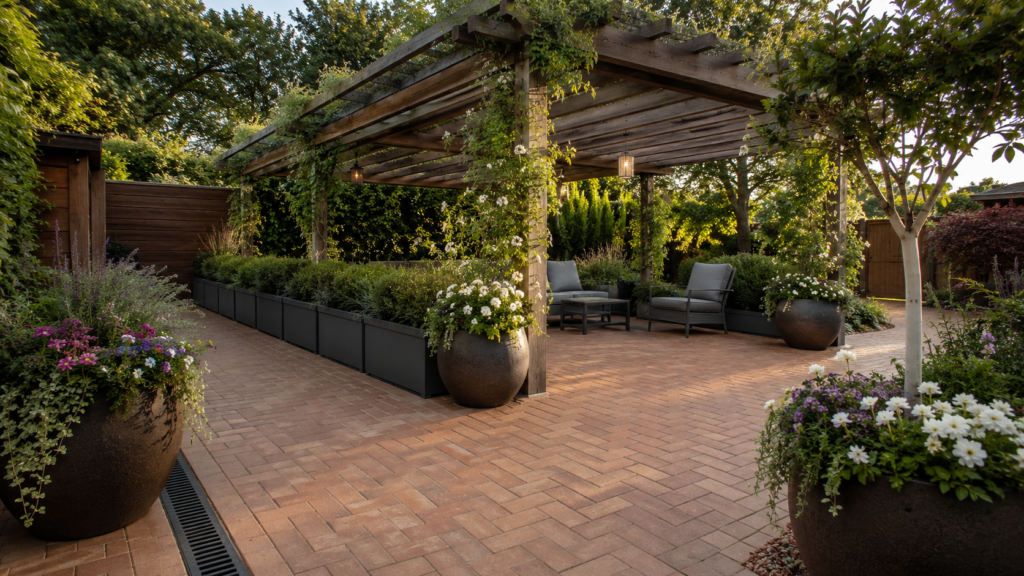
Pergola planter ideas can turn a plain structure into a private, shaded and inviting outdoor room. Use tall troughs for screening, large post-side containers for climbers, narrow planters for compact patios and movable pots for seasonal color. The strongest designs solve a clear problem without blocking entrances, crowding furniture or creating excessive maintenance. Before planting, check light, mature size, root space, wind, drainage and filled container weight.
How We Chose These Pergola Planter Ideas
These ideas were assessed for root volume, stability, mature plant size, drainage, circulation, maintenance and climate adaptability. The list includes built-ins, movable pots, privacy screens, vertical systems and climber arrangements. Plant guidance remains flexible because sunlight, rainfall, winter temperatures and invasive-species rules vary by region.
Choose the Right Pergola Planter
Start with the result you need most:
| Main goal | Best approach |
|---|---|
| Privacy | Tall troughs, ornamental grasses or a planter-mounted trellis |
| Natural shade | Large post planters with manageable climbers |
| Small-space planting | Narrow troughs, wall planters or selected hanging baskets |
| Low maintenance | Large self-watering pots with repeated grasses or evergreens |
| Flexible styling | Mobile corner pots or a three-planter cluster |
| Herbs near a kitchen | A narrow or vertical herb planter away from direct heat |
| Strong focal point | One oversized container with an architectural plant |
Observe the pergola throughout the day because each planter position may have different light. Measure entrances, chair movement and walking routes before buying containers. Keep large pots outside circulation zones and preserve access to outlets, grills, gutters, roof mechanisms and structural posts.
Are Planters Around Pergola Posts Safe?
Freestanding pots can sit beside pergola posts, but decorative containers should not anchor or structurally support the structure. Keep wet growing media away from timber so the post base remains ventilated and visible for inspection.
Check full wet weight, especially on raised decks. Tall shrubs, bamboo, trellises and vines catch wind, so use broad, stable containers. Attach hanging baskets only to suitable structural points after accounting for saturated weight and wind movement.
Best Statement Pergola Planter Ideas
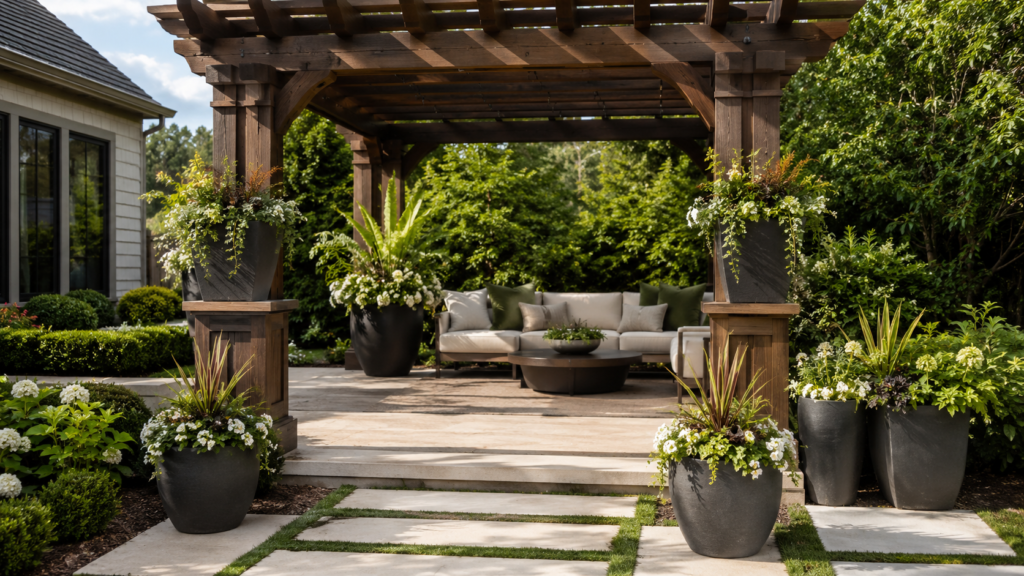
1. Frame the Posts With Matching Planters
Matching containers beside key posts create symmetry and connect the pergola to the garden. Use upright grasses, compact evergreens or columnar shrubs, with optional low flowers. Keep pots separate from posts, preserve drainage and inspection space, and allow for mature width beside walkways.
2. Add One Oversized Focal Planter
One oversized planter can have more impact than several small pots. Place it beside a sofa, in an empty corner or at the end of an indoor sightline. Choose a climate-suitable compact tree, upright evergreen or architectural grass. Position the container before filling because it will become difficult to move.
3. Install Built-In Planters Between Posts
Built-in planters can define a dining or lounge boundary and integrate the pergola with the landscape. Plan waterproof separation, drainage and repair access from the beginning. Use compact grasses, evergreen perennials or manageable shrubs, preferably in removable inserts, and keep runoff away from structural timber and post fixings.
4. Combine a Planter Box With a Bench
A planter bench adds seating and greenery in one footprint and can divide dining and lounge zones. Keep plants below shoulder height and avoid thorny, brittle or spreading species. Separate and waterproof the planting compartment, preserve drainage access and prevent dense growth from dropping debris onto cushions.
5. Line the Entrance With Matching Pots
Two matching pots can define an entrance. Clipped shrubs look formal, while herbs, grasses or seasonal flowers feel relaxed. Keep full passage width for people and furniture, use broad pots in windy areas and repeat the finish elsewhere for cohesion.
6. Create a Three-Planter Cluster
A three-pot cluster can fill an empty corner with one tall plant, one medium mound and one low or trailing layer. Use related colors or materials, group plants with similar water and light needs, and leave gaps for airflow, cleaning and access.
Best Pergola Planter Ideas for Privacy
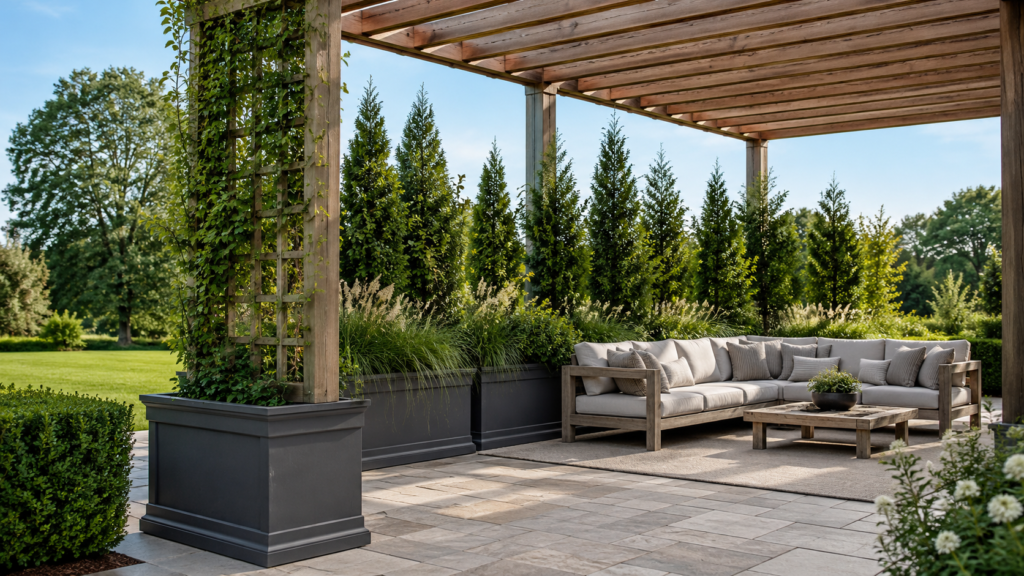
7. Use Tall Rectangular Privacy Planters
Tall rectangular planters provide immediate structure along a neighboring window, open boundary or exposed dining area. Evergreen shrubs give year-round screening, while grasses create a softer, lighter effect.
Check the internal planting volume because some tall decorative containers have false bottoms. A narrow base may also be unstable once the plants become top-heavy. Position the trough along the problem boundary, preserve useful views into the garden and leave enough width for mature foliage.
8. Grow Clumping Bamboo in Containers
Clumping bamboo can form a tall, narrow screen where the species and climate are suitable. Its upright canes provide movement and filtered privacy without creating a dense wall.
Choose clumping rather than running bamboo and verify local restrictions. Even clumping types need generous root space, regular water, feeding and eventual division. Use broad, heavy planters because mature canes catch wind. This option is less suitable where irrigation is limited or leaf drop will be difficult to clean.
9. Add a Planter-Mounted Trellis
A trellis installed in or securely behind a large planter creates a slim privacy screen where broad shrubs would consume too much floor space. It is useful beside a small dining area, boundary or exposed corner.
Install the support before planting and stabilize the complete system against wind. Faster vines give quicker coverage but need more pruning; slower climbers take longer but are easier to control. Preserve access for tying and pruning, and direct growth away from roof mechanisms, lights, gutters and neighboring property.
10. Use Ornamental Grasses as a Soft Screen
Ornamental grasses filter views while allowing light and air to move through the pergola. Their texture and movement suit modern, rustic and naturalistic spaces.
Choose clumping, non-invasive varieties suited to the climate. Some remain evergreen, while others turn brown or need cutting back, so consider whether privacy is required in winter. Repeat one grass variety across two or three broad containers for a calmer, more cohesive design and better wind stability.
11. Create a Hanging Green Curtain
A limited row of hanging planters can soften an open side without using floor space. Trailing foliage or cascading flowers work best when growth remains controlled.
This idea needs suitable attachment points and a watering method that does not drip onto seating or dining tables. Saturated baskets are much heavier than dry ones, and wind adds movement. Use only a few evenly spaced baskets; filling every beam can lower the visual ceiling and create excessive maintenance.
Pergola Planter Ideas for Natural Shade
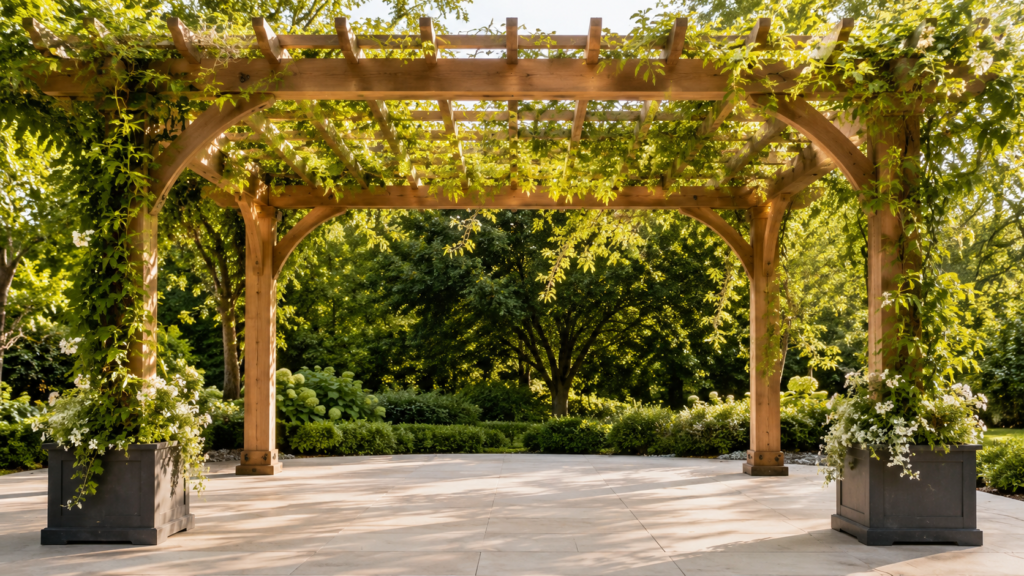
12. Train Container Vines Up the Posts
Place a large planter beside a suitable post and train a climber upward with wires, a trellis or soft ties. One or two carefully managed vines are usually more effective than placing a climber beside every post.
The Royal Horticultural Society notes that most climbers can grow successfully in large containers, but they need regular watering and feeding during the growing season.
Long-lived vines need substantial root volume, consistent water, regular feeding and strong support. Choose a moderately vigorous variety rather than the fastest grower available. Direct stems toward the roof section where shade is needed, remove tangled growth early and inspect fittings regularly as the plant gains weight.
13. Grow Grapevines Across the Roof
A grapevine can create broad summer shade while allowing more light through after its leaves fall. It works best in a sunny climate where annual pruning and seasonal cleanup are realistic.
The support must carry mature stems and foliage. Fruit, flowers and leaves may fall onto furniture, so avoid positioning a productive canopy directly over pale cushions or a dining table. Grapevines grown mainly for fruit often perform better on an open trellis, while pergola vines are commonly valued for shade and atmosphere.
14. Pair a Climbing Rose With a Lighter Vine
A climbing rose paired with a less vigorous clematis or honeysuckle can extend flowering and produce a layered canopy. The rose provides woody structure while the companion fills gaps or flowers at another time.
Separate containers are often easier to manage than forcing two mature climbers into one restricted root zone. Consider thorns, pruning schedules, airflow and mature weight. This romantic combination suits traditional pergolas better than narrow, high-traffic spaces where people may brush against stems.
15. Use Annual Climbers for Fast Coverage
Annual climbers provide quick seasonal color without committing the pergola to a permanent woody vine. They suit renters, temporary displays and gardeners who prefer a new color scheme each year.
Use a medium to large pot with light support, regular feeding and reliable watering. Fast-growing annual vines can dry their containers quickly during warm weather. Remove spent growth at the end of the season, clean the support and refresh or replace tired potting mix before replanting.
Pergola Planter Ideas for Small Spaces
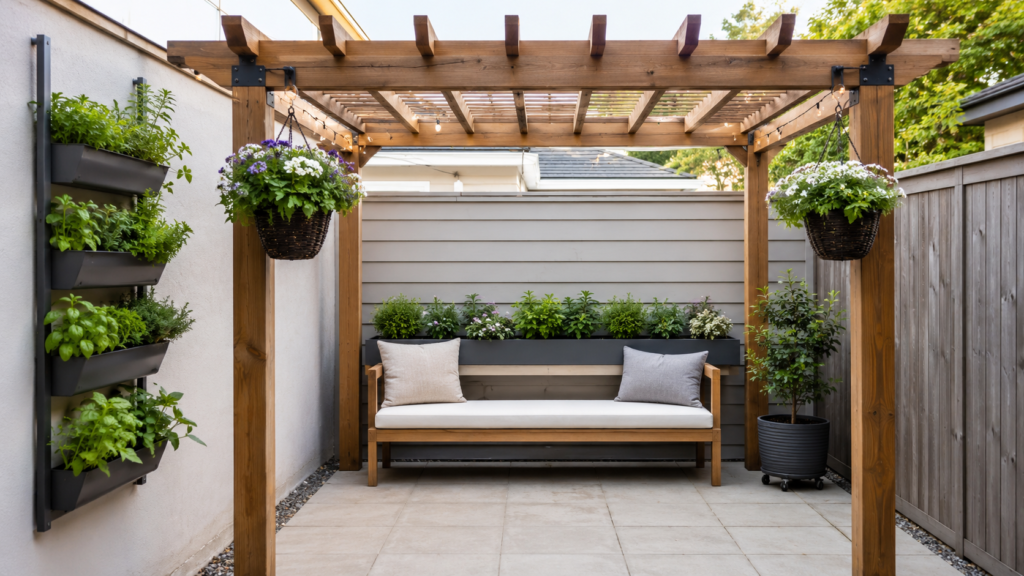
16. Use a Narrow Trough Along One Side
A long, narrow planter softens a railing, wall or exposed boundary without taking the depth of several round pots. It works behind a bench or along the outer edge of a compact pergola.
Choose upright foliage, compact grasses, herbs or seasonal flowers. Avoid broad shrubs that will lean into the usable area. Check the internal width and soil volume, not just the external length, because very narrow troughs may dry quickly and restrict mature roots.
17. Hang Baskets From Selected Beams
Hanging baskets add color at eye level while preserving the floor. Position them near outer corners rather than directly above seats, tables or main paths.
Use a restrained number and repeat the same plant or color palette. Confirm safe attachment, saturated weight, watering access, wind exposure and drainage before installation. In hot weather, baskets may need more frequent moisture checks than large ground-level planters because their exposed sides dry quickly.
18. Mount Planters Behind the Seating
Wall-mounted planters can turn a blank wall behind an attached pergola into a green backdrop. They work well for compact herbs, shallow-rooted foliage and seasonal flowers.
The wall and fixing system must support the full wet weight. Use controlled irrigation and removable inner pots where possible to prevent water from staining painted or porous surfaces. Keep foliage high enough that it does not brush against people, but low enough to water and maintain safely.
19. Add a Vertical Herb Planter
A vertical or stackable planter can hold several herbs in a small footprint near an outdoor kitchen. Place it where the plants receive suitable light but remain away from grill heat, smoke and grease.
Group herbs by moisture needs. Rosemary, thyme and oregano prefer freer-draining conditions, while basil and parsley usually need more consistent moisture. Keep vigorous mint in its own section. Make sure every tier drains without flooding the plants below.
20. Use Mobile Corner Planters
Mobile planters create flexible structure in selected corners. Move them outward for gatherings, bring them closer to seating for a more enclosed feel or roll tender plants into shelter during cold weather.
Use load-rated bases with locking wheels and test the surface before filling the pots. Repeat one plant variety or use two complementary species so the layout remains cohesive. Mobility is most useful when the plants can be moved safely without crossing steps or uneven paving.
21. Add Railing Planters to a Raised Deck
Railing planters preserve deck space and can hold flowers, herbs or controlled trailing foliage. They are useful where freestanding pots would obstruct a narrow platform.
Choose an attachment system designed for the railing and account for wet weight, wind and watering runoff. Do not obstruct the handrail or allow containers to project over a public walkway. Keep trailing stems pruned so they do not interfere with lower levels or neighboring property.
Best Plants for Pergola Planters
Choose plants by function, light and mature root needs:
- For vertical flowers: Moderately vigorous clematis, selected jasmine and compact climbing roses.
- For fragrance: Jasmine, honeysuckle and suitable flowering herbs.
- For year-round privacy: Climate-appropriate evergreen shrubs or clumping bamboo.
- For filtered screening: Ornamental grasses.
- For shaded areas: Ferns and shade-tolerant foliage plants.
- For seasonal color: Annual climbers, flowering annuals and trailing plants.
- For edible planting: Mediterranean herbs, soft herbs and suitable fruiting vines.
Plants sharing one container should prefer similar light, moisture and feeding conditions. Avoid combining a drought-tolerant herb with a thirsty foliage plant simply because they look attractive together.
What Size Planter Do You Need?
Planter size should reflect mature roots and stability, not the plant’s nursery pot. As a practical starting point, seasonal flowers may use containers around 25–35 cm wide, mixed ornamentals 35–50 cm, and tall grasses or compact shrubs 45–60 cm. Long-lived climbers often need a container around 50–70 cm wide and deep, while small trees usually require 60 cm or more.
Check internal dimensions because tapered sides and false bottoms reduce usable volume. Larger pots hold moisture more steadily and resist tipping, but they are heavier and can remain wet longer. Position large containers before filling them and confirm raised-deck capacity when necessary.
Match the Planter to the Pergola
Wooden pergolas work naturally with terracotta, lined timber, weathered stone and matte composite pots. Keep wet growing media separated from structural timber.
Modern metal pergolas suit geometric fiberglass, powder-coated metal and smooth composite planters. Pale or insulated finishes can help protect roots in strong sun, while broad concrete or heavy ceramic pots provide stability in exposed areas.
For mobility, fiberglass and quality composite are practical. Terracotta offers warmth but dries quickly and may crack in frost. Metal can heat roots, wood needs lining, and concrete is difficult to move. Choose material according to climate, weight and maintenance rather than appearance alone.
Pergola Planters for Different Climates
In hot, dry climates, choose large pale or insulated planters, add mulch and use drip irrigation to reduce rapid moisture loss and root heat. Humid areas need open planting, reliable drainage and wider spacing to improve airflow. In cold or frosty regions, use frost-resistant movable containers and protect tender roots from prolonged freezing. Coastal and windy sites require broad, heavy pots with salt- and wind-tolerant plants. Tropical conditions favor generous containers but demand frequent pruning because growth can be rapid. In rainy climates, raise containers on feet and keep outlets clear to prevent waterlogging. Containers beneath a pergola roof may receive little rainfall, so adjust irrigation according to each pot’s actual exposure rather than the surrounding weather.
How to Arrange Pergola Planters
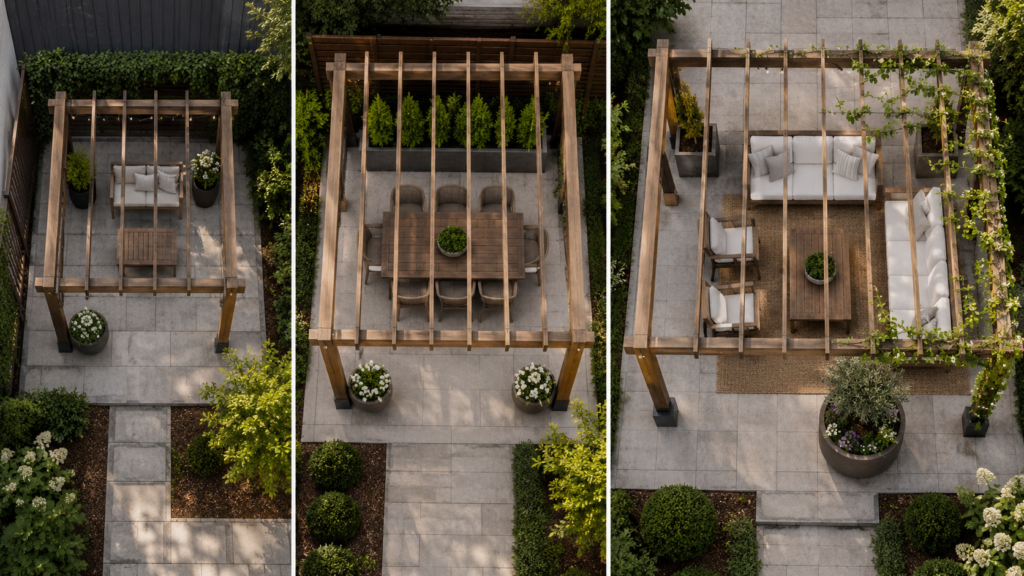
Keep the main entrance open and place the tallest planting along the exposed boundary. Preserve attractive garden views, leave space behind chairs and keep access to drains, outlets and structural posts.
For a compact 8 × 8-foot pergola, use no more than three main containers: one vertical feature on the least attractive side and two compact corner pots. A 10 × 12-foot dining pergola can use two entrance planters and narrow privacy troughs behind the chair zone. A 12 × 16-foot lounge pergola can handle larger corner planters, one focal pot and one or two trained vines.
Repeat structural plants rather than giving every container a different dominant species. A limited palette makes the pergola feel larger and simplifies care.
Watering, Drainage and Low-Maintenance Care
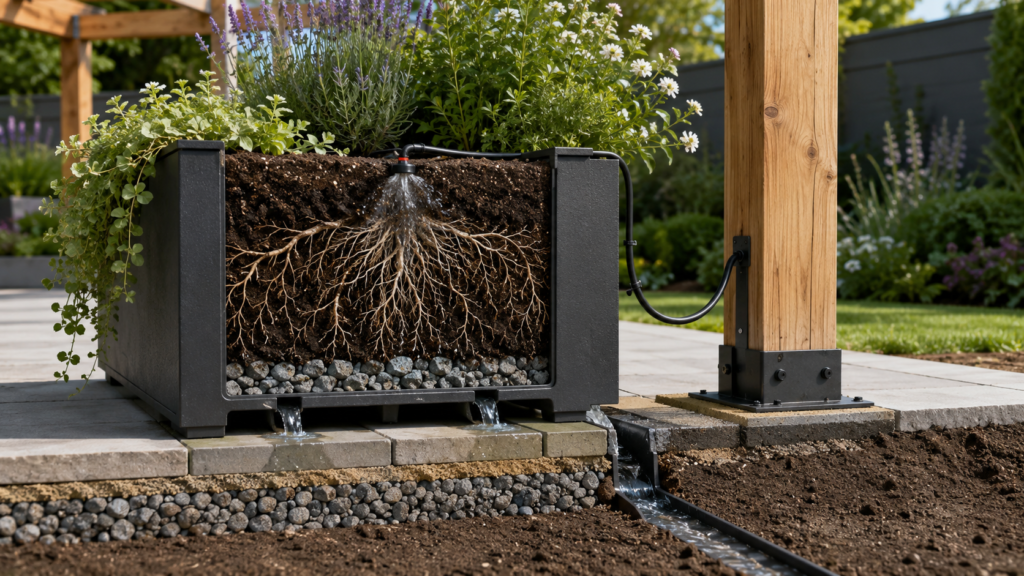
Every planter needs open drainage holes and a route that carries excess water away from timber, furniture, paving and electrical fittings. Raise pots on feet where necessary, avoid permanently full saucers and check outlets after storms.
Drip irrigation is useful for several large containers with similar needs. Self-watering pots can reduce daily work, but reservoirs and overflow holes still require inspection. Water according to actual soil moisture rather than a fixed calendar. Hanging baskets, annual climbers and sunny metal pots often dry faster than large shaded containers beneath the roof.
For lower maintenance, use fewer and larger containers, climate-adapted plants, mulch and a repeated planting palette. Compact evergreens, manageable grasses and drought-tolerant herbs are generally easier than many small pots of thirsty seasonal flowers. Low maintenance still includes feeding, pruning, pest checks, drainage inspection and occasional potting-mix renewal.
Pergola Planter Mistakes to Avoid
Avoid choosing plants before checking sunlight, using small pots for vigorous climbers or blocking entrances with mature foliage. Do not allow runoff to collect around posts, hang unverified weight from beams or mix plants with incompatible water needs.
Other common mistakes include ignoring mature spread, using invasive species, overfilling a small pergola and training vines into gutters, lights, electrical cables or retractable roof mechanisms. Leave enough space between large pots for cleaning, airflow and inspection.
Seasonal Care
In spring, check drainage, refresh the top layer of potting mix, feed established plants and tie new vine growth. In summer, monitor moisture more frequently, mulch exposed soil and protect roots from reflected heat.
During autumn, remove vines from gutters and lighting, reduce feeding as growth slows and prepare tender containers for shelter. In winter, protect vulnerable pots from freezing, prevent waterlogging and inspect exposed planters after storms.
Keep permanent structural plants as the foundation and change only selected flowers or herbs. This preserves a cohesive design while reducing cost and root disturbance.
Which Pergola Planter Idea Is Best?
Tall rectangular planters are the strongest option for privacy, while large post planters with manageable vines work best for natural shade. Narrow troughs, wall planters and selected baskets suit compact pergolas. Mobile pots are useful for renters, and large self-watering containers with grasses or evergreens are usually the easiest to maintain.
Most pergolas need only two to five main containers. A strong arrangement combines one structural feature, one practical solution and one seasonal accent rather than using all 21 ideas at once.
Pergola Planter Ideas FAQs
Can Planters Safely Surround Pergola Posts?
Yes, when they remain separate from the structural post. Keep wet soil away from timber, leave the post base visible and direct runoff away from fixings.
Can a Planter Anchor a Pergola?
A standard decorative planter should not act as a structural anchor. Use a planter-based foundation only when the complete system has been engineered and approved for that purpose.
How Deep Should a Pergola Vine Planter Be?
A long-lived climber often needs a container around 50–70 cm wide and deep as a planning starting point. The final size depends on the species, vigor, mature roots and expected lifespan.
Which Plants Give the Most Privacy?
Evergreen shrubs, ornamental grasses, clumping bamboo and trellis-trained vines can provide effective screening. Use broad containers that support mature growth and resist wind.
What Grows Beneath a Shaded Pergola?
Ferns, begonias, coleus and other shade-tolerant foliage plants can work well beneath a pergola. Check each position separately because containers near outer posts may receive much more sun than pots beneath the center of the roof.
How Do You Prevent Planters From Staining the Patio?
Raise containers on planter feet, keep drainage holes open and direct runoff toward a suitable outlet. Empty saucers regularly and avoid allowing fertilizer-rich water to remain on porous paving, timber decking or light-colored stone.
Can Hanging Planters Damage a Pergola?
They can if saturated weight, wind movement or unsuitable fixings exceed the beam’s capacity. Attach baskets only to approved structural points, calculate their full wet weight and keep them away from lights, retractable roofs and seating areas.
How Often Should Pergola Planters Be Watered?
Check the growing mix and water according to actual moisture. Sun, wind, planter material, root density and rain exposure all affect drying speed.
How Many Planters Does a Pergola Need?
Most pergolas need two to five main containers. Fewer, properly scaled planters usually look better and leave more usable space than a pot beside every post.
Conclusion
The best pergola planter ideas improve privacy, shade or function without reducing safety and comfort. Match every plant to the exact light, provide enough root space, use stable containers and plan drainage before decorating. Two or three compatible features will usually create a stronger, easier-to-maintain pergola than a crowded collection of unrelated pots.

Myra is the founder and lead writer of Backyard Planter Ideas, where she shares practical, well-researched guidance on planter design, plant selection, and outdoor styling. Her goal is to help homeowners create attractive, functional garden spaces with clear, reliable, and easy-to-apply advice.